

Economics helps us understand how individuals, businesses, and governments make decisions about scarce resources. Within the field of economics, two important approaches are commonly used: **positive economics** and **normative economics**.
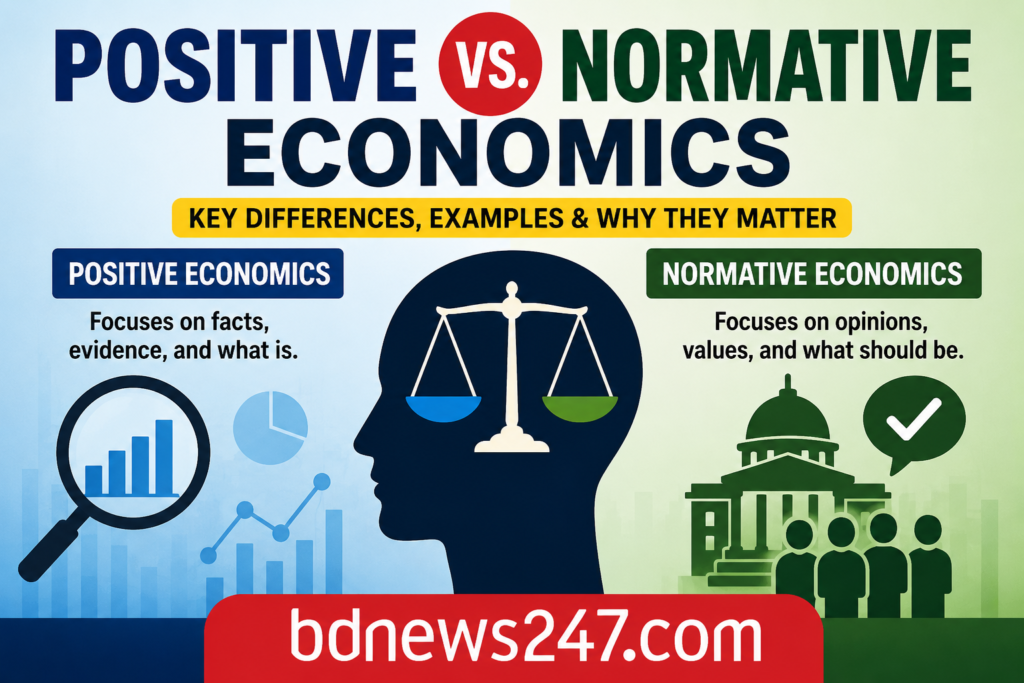
Although the two concepts are closely related, they serve different purposes. Positive economics focuses on facts and objective analysis, while normative economics involves opinions, values, and what people believe should happen.
In this article, we’ll explore the differences between positive and normative economics, provide practical examples, and explain why understanding both is important.
What Is Positive Economics?
Positive economics deals with **objective facts, data, and cause-and-effect relationships**. It seeks to explain economic phenomena without making judgments about whether the outcomes are good or bad.
Statements in positive economics can be tested, verified, or disproven using evidence and data.
Examples of Positive Economics
* Increasing the minimum wage may reduce employment opportunities for some low-skilled workers.
* Higher interest rates generally reduce borrowing and spending.
* A rise in gasoline prices often leads to lower consumer demand.
These statements describe what is happening or what may happen based on economic evidence.
What Is Normative Economics?
Normative economics focuses on **value judgments, opinions, and policy recommendations**. It addresses questions about what the economy should be like and what actions should be taken.
Unlike positive economics, normative statements cannot be proven true or false solely through data because they are based on personal beliefs, ethics, or societal values.
Examples of Normative Economics
* The government should increase the minimum wage to reduce income inequality.
* Wealthy individuals ought to pay higher taxes.
* Healthcare should be free for all citizens.
These statements reflect opinions about what is desirable rather than objective facts.
Positive vs. Normative Economics: Main Differences
| Positive Economics | Normative Economics |
| ——————————— | ——————————— |
| Based on facts and evidence | Based on values and opinions |
| Objective | Subjective |
| Can be tested and verified | Cannot be proven solely with data |
| Describes what is | Describes what should be |
| Used for analysis and forecasting | Used for policy recommendations |
Real-World Example
Consider a proposal to increase the federal minimum wage.
**Positive economics** asks:
* How will employment levels change?
* What impact will it have on business costs?
* Will consumer spending increase?
**Normative economics** asks:
* Should workers earn a higher minimum wage?
* Is reducing income inequality more important than potential job losses?
* What is the fairest wage policy?
Both perspectives are important because policymakers often use factual analysis alongside social values when making decisions.
Why Both Matter
Positive economics provides the evidence needed to understand economic outcomes. Normative economics helps societies decide which outcomes are desirable and worth pursuing.
For example, economic research may show that a policy increases government spending. Whether that policy is worth implementing depends on broader social goals and values.
As a result, effective public policy often combines positive economic analysis with normative judgments.
Common Mistakes People Make
Many people confuse factual claims with value-based opinions. When discussing economic issues, it’s helpful to ask:
* Is this statement describing facts or data?
* Is it expressing an opinion about what should happen?
Recognizing the difference can lead to more productive discussions about economic policy and public issues.
Conclusion
Positive and normative economics are two essential approaches to understanding economic issues. Positive economics focuses on facts, evidence, and objective analysis, while normative economics focuses on values, opinions, and policy goals. Together, they provide a more complete framework for evaluating economic decisions and shaping public policy.
Key Takeaways
* Positive economics focuses on facts, evidence, and measurable outcomes.
* Normative economics involves opinions, values, and policy recommendations.
* Positive statements can be tested and verified using data.
* Normative statements reflect beliefs about what should happen.
* Policymakers often rely on both positive and normative economics when making decisions.
* Understanding the distinction helps improve economic analysis and public debate.